
Do you know any interesting facts about Cotopaxi? Volcan Cotopaxi is an active stratovolcano in the Cordillera Central range of the Andes in Ecuador. The volcano sits about 50 kilometers south of Quito. It is the 2nd highest summit in Ecuador and one of the world’s highest volcanoes.

Situated in the 33,393 hectare Cotopaxi National Park in the provinces of Cotopaxi, Pichincha, and Napo, Volcan Cotopaxi is a popular destination for mountain enthusiasts. It’s a simple and straightforward climb up the snow covered symmetrical peak to the summit of Cotopaxi.
Volcan Cotopaxi Quick Facts:
- Elevation: 19,347 feet | 5897 meters
- Prominence: 7887 feet | 2404 meters
- Isolation: 59.58 miles | 95.89 kilometers
- Lat/Long: -0.68062, -78.438049
- Range:Cordillera Central, Ecuador Andes
- First Ascent: 1872 – Wilhelm Reiss & Angel Escobar
- Weather Forecast: Cotopaxi, Ecuador
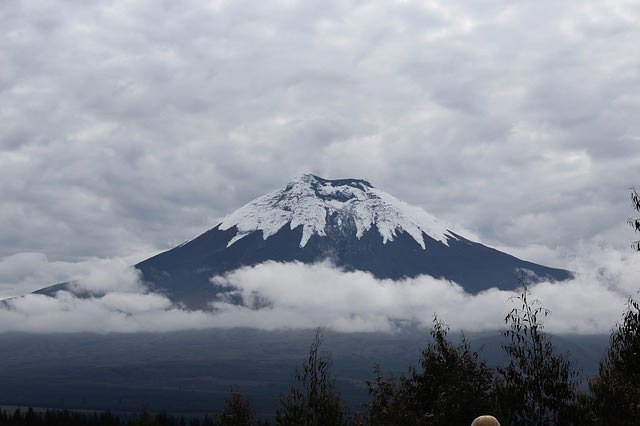
Let’s look at some interesting facts about Volcan Cotopaxi, Ecuador:
- Cotopaxi lies in the Cordillera Central in the Andes of Ecuador.
- It’s the 2nd highest summit in Ecuador – only Chimborazo is taller at 20,564′.
- Located roughly 50 kilometers south of Quito, Cotopaxi lies entirely within the Cotopaxi National Park.
- Cotopaxi National Park was established in 1979 and is Ecuador’s second largest national park – only Galapgos Islands National Park is larger.
- Cotopaxi National Park is also home to two other volcanoes – Sincholagua Volcano and Ruminawi Volcano.
- Volcan Cotopaxi is part of the Pacific Ring Of Fire.
- The volcano rises to 19,347 feet | 5897 meters.
- It is roughly 23 kilometers wide and its base. At its summit, Cotopaxi has two concentric crater rims. The crater measures roughly 800 x 550 meters wide and 250 meters deep.
- Cotopaxi’s highest point is on the outer crater rim on the north side.
- Volcan Cotopaxi is home to one of the few equatorial glaciers in the world.
- Cotopaxi is an active stratovolcano. Its 1st recorded eruption was in 1534. It has erupted over 50 times since 1738.
- In 1744 an 1768 the volcanic eruption destroyed the town of Latacunga
- On June 26, 1877 pyroclastic flows destroyed the ice cap and lahars traveled over 100 kilometers to the Pacific Ocean.
- To get the latest updates on Cotopaxi’s volcanic activity, visit IGEPN.edu.ec.
- An outdoor retail company named themselves after the volcano. Shop at Cotopaxi.com to learn more.
- A town in Fremont County Colorado is also named Cotopaxi. It has a population of 47 as of the 2010 census.
- Cotopaxi has been featured in numerous paintings, books, poems, movies, and other forms of pop culture.
- Locals consider Cotopaxi to be a sacred mountain.

Let’s look at some climbing history on Cotopaxi, Ecuador:
- In 1802, Alexander von Humboldt became the 1st person to attempt to summit the volcano.
- On November 28, 1872, German geologist Wilhelm Reiss and Colombian Angel Escobar were the 1st climbers to summit Cotopaxi.
- In 1972 a Polish-Czech team made the 1st descend into the crater.
- Today, Cotopaxi is a major climbing destination that is climbable year round. About a hundred people attempt to climb Cotopaxi every weekend. The climb is a simple and straightforward scramble that requires crampons and ice axes. The mountain sees about a 50% success rate.
- Since December 2012, all climbs on peaks over 5000 meters in Ecuador require a licensed guide – this includes Cotopaxi.
- A 4×4 road travels up to 4600 meters on the north side of Cotopaxi.
- In 1971 the Jose F Ribas Refuge was built at 4800 meters. It is built in a valley at the bottom of an avalanche path.
- On Easter Sunday in 1996, an avalanche hit the refuge and 13 people ultimately died on the slopes of Cotopaxi.
- The easiest route is the Glacier/Snow Climb on the north side of the volcano.
To learn about different routes on the mountain, visit SummitPost.org.
Find Cotopaxi, Ecuador On Google Maps:
Feel free to contact us if any of the above information is incorrect or if you know of additional interesting facts about Cotopaxi, Ecuador.

By Simon Matzinger – Own work, CC BY-SA 3.0, Link
Discover More Interesting Mountain Facts


