
Climbing Worker Bee – 5.7 – on Beehive Peak in the Madison Range of Montana
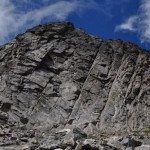
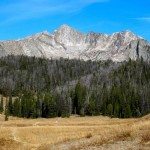
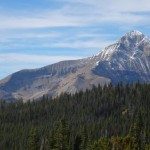
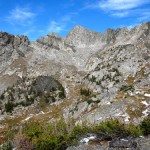
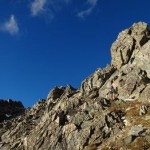
Beehive Peak is the second highest peak in the Spanish Peaks. The south face of Beehive Peak is home to many established alpine climbing routes. For this alpine adventure, our route of choice is Worker Bee – a 4 pitch, 5.7 alpine climb that ascends approximately 450′.

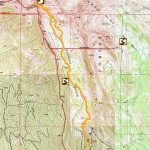
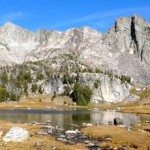
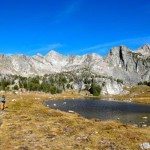
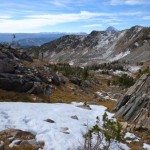
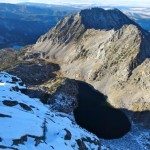
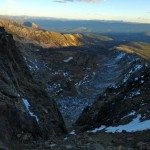
In early October, Opie Jahn and I set out to climb Worker Bee. During the approach, the views were outstanding, the lake was pristine, and the glacial carved valley was stunning. We made good time up the trail, until we reached the end of the maintained Beehive Basin Trail. Then we continued off-trail to the base of the climb.

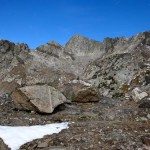
After a quick rock hop and goat-like scramble toward Beehive Peak, we found a good place to ditch our packs. I used my MSR Dromlite to hydrate as we sorted gear and got ready for a fast and light climb.

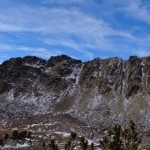
With Beehive’s South Face looming overhead, we caught glimpses of New World Route (5.8) and Life of A Drone Bee (5.7). So many options!

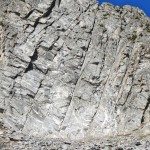
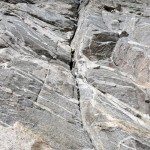
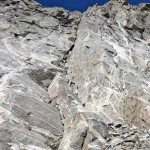
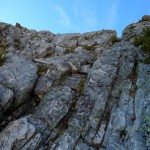
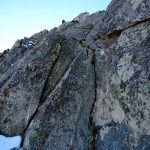
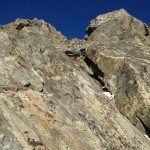
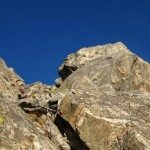
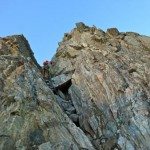
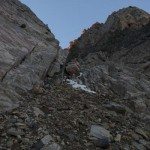
Worker Bee is an obvious left dihedral that starts in an obvious crack that leads to a chimney system. It is easy to distinguish this route from a distance because it ends in an obvious notch on the East Ridge. The crack you can see as you approach is actually a series of chimneys that can easily swallow a person. The climb starts at an elevation of about 10300′. The entire route consisted of 4 pitches and approximately 445′ of climbing.

Worker Bee can be pitched out in numerous different ways and there are plenty of variations. The following is a description of our route on this trip.
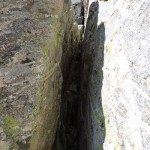
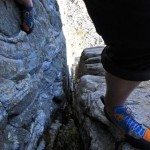
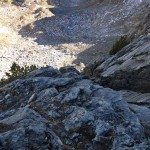
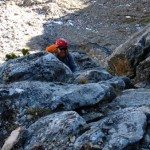
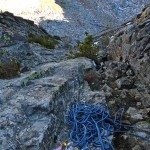
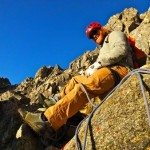
Pitch 1 of Worker Bee starts out nice and easy. It follows a crack for about 30 meters when it hits a chimney system. The chimney has obviously been climbed numerous times, which is evident from the sunglasses and numerous slings in the chimney. It is possible to climb this section if you are a tiny child or an abnormally small adult with out a rack or pack or a belly. I was unable to maneuver my way through this constricting squeeze chimney and had to down climb this sketchy section.
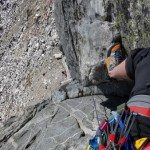
As an option for normally sized people, a face on climber’s left makes for easier climbing up and over the chimney section. Above the squeeze chimney, there is a nice ledge to belay from. It’s tiny, but it does the trick. It is approximately 50 meters to this belay.


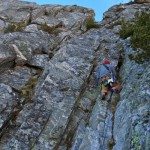
Pitch 2 lead up a wet section of rock into yet another chimney. This chimney is climbable! It’s easy to stem your way up this section. A combination of stem moves, foot placements, and hand holds make this section easier than expected, but the protection is limited so be careful. It’s nice to have some tiny cams like Black Diamond X4’s for this section. Above this chimney is a decent belay ledge. This pitch was approximately 40 meters.


For Pitch 3, there is an obvious, larger chimney directly above the belay ledge. Doing a bit of detective work, we noticed that it was mossy, dark, cold, and wet from our late September snow fall. We tip-toed out to the face on climber’s right side. This turned out to be a magnificent choice. It was nice, quick, mellow crack climbing. In approximately 40 meters, there was a large belay ledge to set up shop.


The fourth pitch is almost more of a scramble than a climb. It can be climbed quickly and ends in the notch on the East Ridge.


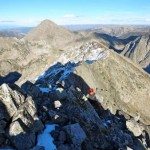
The final section of the climb follows the East Ridge, aka Follow The Swarm, to the summit of Beehive Peak. From the notch at the end of Worker Bee, the climbing is easy, but the exposure is massive. We kept the rope on for the last push. It mostly follows a grassy ledge with a few simple climbing moves.


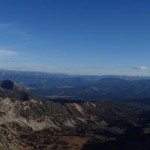
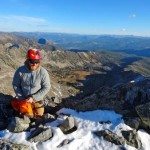
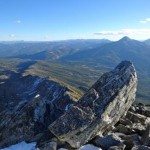
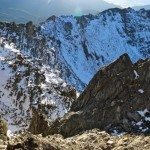
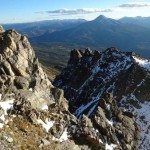
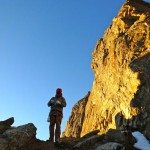
The summit of Beehive Peak at 10742′ offers jaw-dropping views in every direction – Gallatin Peak, The Blaze, Beehive Basin, Big Sky Town Center, Lone Mountain, The Taylor-Hilgards, Cedar Mountain, The Madison Valley. Everywhere you look is amazing.


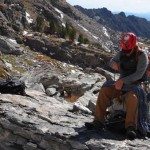
I quickly switched out of my Scarpa Techno X climbing shoes and put on my La Sportiva Boulder X approach shoes for the down climb. Opie threw on his approach shoes and his new Patagonia Nano Air. Unlike when I climbed What’s Left, we opted to descend the standard route – down the 4th of July Gully.
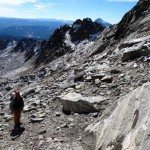
The descent route begins on the west side of Beehive Peak. It’s an easy down climb with lots of large, loose rocks. One the size of a Bosu Ball pummeled down near our rappel. Yikes! After the first 10 meters, we set up a rappel off a large horn. At the bottom of the rappel, we followed a grassy ledge leading south toward the 4th of July Chimney. We rappelled this chimney to the col between the 4th of July Gully and North Twin.


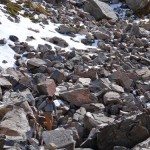
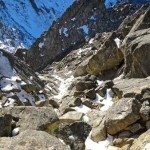
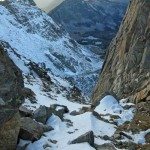
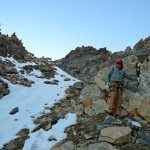
Descending the 4th of July Gully was the way back to the packs. It was full of loose rock, scree, and snow. We walked down this sketchy, 4th class terrain until we got near the base of What’s Left. From there, we set up a 3rd and final rappel to the base of the 4th of July Gully. From here it is easy to find a climber’s trail that led back to the backpacks.


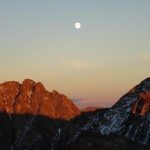
The sun was starting to set and a full moon was rising over Bear Basin as we geared up for the hike back to the Beehive Basin Trailhead. The trail was bathed in moonlight, so our headlamps weren’t entirely necessary.


The entire adventure took over 10 hours, covered 9.35 miles, and totaled 3250 vertical feet. It was epic. Climbing Worker Bee on Beehive Peak is well worth the effort. It’s an easily accessible, classic climb on an iconic mountain. Montana rocks.

Enjoy and climb safe.
_________________________________________________
Learn more about climbing Beehive Peak from:
- Select Peaks of the Greater Yellowstone by Tom Turiano
- Bozeman Rock Climbs by Bill Dockins and Tom Kalakay
- Select Alpine Climbs To Montana by Ron Brunckhorst
_________________________________________________
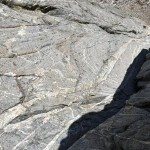
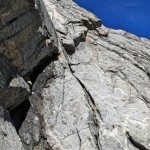
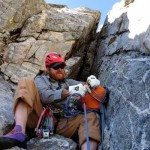
Enjoy some additional images of climbing Worker Bee on Beehive Peak:



_________________________________________________
This route was climbed on October 6, 2014.


